


Website Redesign Services: How to Choose the Best Web Design Company
Most businesses start thinking about a redesign for a simple reason: the website looks old. But in our experience, an outdated look is rarely the whole story. Behind it there is usually a slow site, a frustrating mobile experience, or a layout that confuses visitors before they ever send an inquiry.
If you are comparing website redesign services right now, this guide explains what a good redesign involves, what mistakes to avoid, and how to choose a website design company that will improve your results, not just your colour scheme.
Why Businesses Usually Come to Us for a Redesign
The clients who reach out to us for a redesign are usually dealing with the same three problems:
- A poor mobile experience
- A weak or confusing UI design
- Slow site performance
These problems feed each other. A slow page makes visitors leave, a cramped mobile layout makes them struggle, and an unclear design means they never find the enquiry form. Fixing one without the others rarely moves the needle.
A Real Example: Taking a Slow Website From 49 to 90
One of our clients had a website that took too long to open. Before touching anything, we audited it, and the numbers explained the frustration:
- Overall performance score: 49
- Mobile performance score: 52
- Total blocking time: 410 ms
- Largest Contentful Paint (LCP): 3.6 seconds
- Speed Index: 3.8 seconds
What we fixed
We went through the site piece by piece instead of guessing. We removed unused JavaScript and CSS files, reduced the pixel dimensions of oversized images, and switched the images to WebP. These are not flashy changes, but they are the ones that actually make pages load faster. After the work, the performance score reached 90.
What changed for the business
Speed was only half of the story. We also improved the UI and made the site properly responsive and mobile-friendly. Visitors could now understand the pages easily and use the site without effort. Engagement improved, and leads started coming in.
The lesson we took from this project is that a redesign works when a site feels intuitive. People should not need to work out how to use it.
Start With Research, Not Visuals
If we had to defend one stage of the redesign process above all others, it would be the website audit and planning stage. Every decision that follows depends on knowing what is already working, what is broken, and what the business actually needs.
This is also the stage that gets rushed most often. Many agencies, and many clients, jump straight into visual design without looking at user behaviour, existing SEO performance, conversion problems, or customer expectations.
Here is a common example. A website looks outdated, so everyone assumes it needs a fresh look. But the real problem might be confusing navigation or an enquiry form that is far too complicated. Changing colours and layouts will not fix either of those.
A successful redesign starts with research. If you do not identify the real problem first, you risk ending up with a better-looking website that delivers the same disappointing results.
Our Website Redesign Process, Step by Step
A clear process keeps a redesign from turning into guesswork. This is how we approach it:
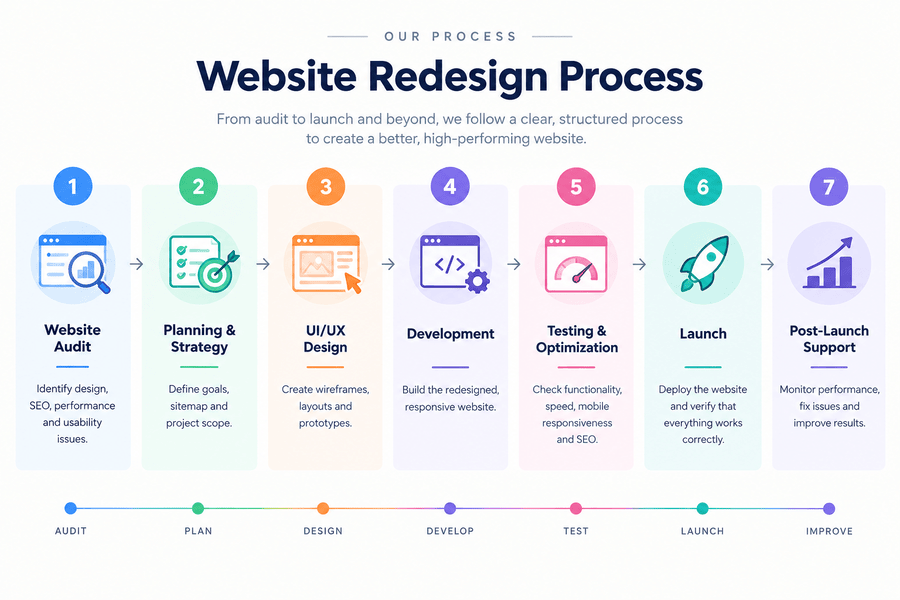
Notice that three of the seven steps happen before a single page is built, and one happens after launch. That balance is deliberate.
Common Mistakes When Choosing a Web Design Company
Choosing the cheapest option
A low quote can look attractive, but price alone tells you nothing about what you are getting. Cheaper options often cut corners on research, performance, and testing, and those are exactly the areas that decide whether the site produces results.
Ignoring SEO during the redesign
A redesign that overlooks SEO can undo rankings you spent years building. Changed URLs, missing redirects, lost metadata, and broken technical foundations can all cause traffic to fall after launch. If a web design agency cannot explain how it will protect your existing search visibility, take that seriously.
A Redesign Is Not Finished at Launch
Creating a website is not enough. A site only keeps delivering results if someone maintains it, and technical SEO is a big part of that. After launch, we check for things like:
- Broken URLs
- Keyword cannibalization, where several pages compete for the same search term
- Proper canonical tags
Many agencies stop at launch. We think that is when the ongoing work begins, because problems like these quietly build up over time and hurt rankings if nobody is watching.
What to Check When Comparing Web Design Companies
Use this list when you are comparing proposals:
- Portfolio and experience: review live websites, mobile layouts, and projects relevant to your industry
- UI/UX expertise: check whether the company prioritizes usability, navigation, accessibility, and conversions, not just visual appeal
- SEO knowledge: ask how they protect existing rankings, URLs, redirects, metadata, and technical SEO during a redesign
- Transparent pricing: compare deliverables, revision limits, additional costs, and payment milestones
- Development capabilities: confirm the team can handle your required integrations, functionality, and technology stack
- Communication and timelines: make sure responsibilities, milestones, approvals, and deadlines are clearly defined
- Ownership and ongoing support: verify that you will control your domain, hosting, website files, and relevant accounts, and understand the maintenance terms
Warning signs to watch for
Based on the points above, be careful if an agency cannot explain how it will protect your rankings, gives pricing that is vague about what is included, or is unclear about who will own your domain, hosting, and website files. Ownership in particular is something many business owners only think about when they are already locked out.
What to Do Before You Contact Any Agency
A little preparation makes the whole project smoother and helps you judge proposals properly.
- Audit your current website: identify issues with design, mobile usability, loading speed, SEO, and conversions
- Define your goals: decide whether you want more enquiries, a better user experience, improved search visibility, or increased sales
- Review your analytics: check website traffic, conversion rates, and the pages where visitors drop off, if that data is available
- Set a realistic budget: establish a budget range and identify the essential features
- Prepare the right questions: ask agencies about their process, SEO migration, project timelines, deliverables, ownership, and post-launch support
Final Thoughts
A website redesign is not just about changing how a site looks. It is about improving how it works for your business and your customers. A visually attractive site is valuable, but if it loads slowly, confuses visitors, performs poorly on mobile, or fails to generate enquiries, better visuals alone will not solve those problems.
The best web design company is the one that treats user experience, speed, SEO, accessibility, and conversion rates as part of one strategy, and keeps looking after the site once it goes live.