


Web Design Trends That Actually Improve User Experience
People decide whether they trust your website in about 50 milliseconds. Roughly 94% of that snap judgment comes down to design, not your copy or your offer, according to first-impression research from the CXL Institute. That's faster than a blink, and it happens before anyone reads a single word about what you do.
That's really the problem this article is about. Plenty of businesses have decent products but their website quietly loses customers before the sales pitch even starts. Nothing's technically broken - it loads, the buttons work, but it doesn't feel trustworthy, and people leave without ever saying why.
If that sounds familiar, it's usually a sign to talk to the best website designing company in Ludhiana rather than patch things again.
What UX Design Actually Means
UX design is how a website feels and functions for the person using it, how fast it loads, how easily they find what they need, whether the whole thing feels effortless or like a chore. It sits next to UI (the visual layer) but goes deeper into behavior and flow. Good UX usually includes intuitive navigation, quick load times, clear visual hierarchy, accessible design, and content built around what the visitor actually wants to do, not what the company wants to say.
Why Businesses Are Bothering With This
It's not vanity spending. Better UX tends to mean fewer people bouncing off the homepage, more form fills from the same traffic, lower cart abandonment, and stronger mobile conversion, most traffic arrives on a phone now anyway. Credibility matters more in B2B sales cycles than people give it credit for.
One thing worth understanding before you commit to anything: website design and development cost in Ludhiana varies a lot depending on whether you need a light refresh or a full UX rebuild, so it's worth getting a proper quote instead of comparing generic price lists.
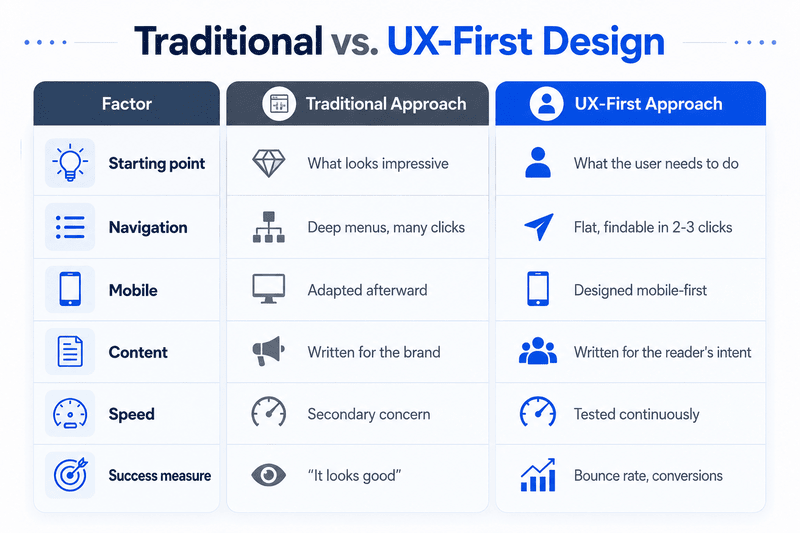
Traditional vs. UX-First Design
Most of what separates a mediocre site from a genuinely useful one comes down to this shift below. It's worth walking through each row honestly with your website designing company in Ludhiana before a single wireframe gets drawn.
Motion, Mobile, and Accessibility: Where Most of the Real Work Happens
Animation gets misused a lot. Done badly it's just distracting; done well it quietly guides attention, hover states that confirm a button works, scroll reveals that break up a long page, instant feedback on a form error instead of a wall of red after submission.
Mobile isn't a "trend" anymore, it's the baseline. Touch targets sized for thumbs, layouts that reflow instead of just shrinking, navigation that collapses sensibly, forms short enough to actually finish on a phone.
Accessibility used to get treated as a compliance checkbox. That's changing, search engines increasingly favor accessible sites, and it simply widens who can use yours at all: contrast that's actually readable, keyboard navigation, alt text, captioned video.
We rebuilt this thinking into a recent healthcare project, where accessibility and speed directly affected sign-up completion. You can see how it played out in our OnCallDrs case study.
Mittal Technologies Insight: Clients often ask for more animation than the site needs. Our rule is simple, motion should explain or confirm something. If it's pure decoration, it's usually just slowing the page down.
How a UX-Focused Rebuild Actually Runs
- Audit the current site and find where users drop off
- Map what each visitor type is actually trying to do
- Wireframe around tasks, not just aesthetics
- Build the visual system - typography, color, imagery
- Test with real users before and after launch, then watch the numbers for 60-90 days
Where Redesigns Usually Go Wrong
Stakeholders want everything above the fold, fix this by prioritizing based on where users actually scroll, not opinion. Mobile gets treated as a shrunk-down desktop site, designed independently instead. Page speed dies under too many tracking scripts, audit plugins every quarter and cut what isn't earning its place. Accessibility gets skipped under deadline pressure, build it into the design phase, not a post-launch patch.
None of these are exotic problems. Most businesses searching for the best IT company in Ludhiana are already dealing with at least two of them, which is exactly why it helps to know where your site actually sits before you start fixing anything.
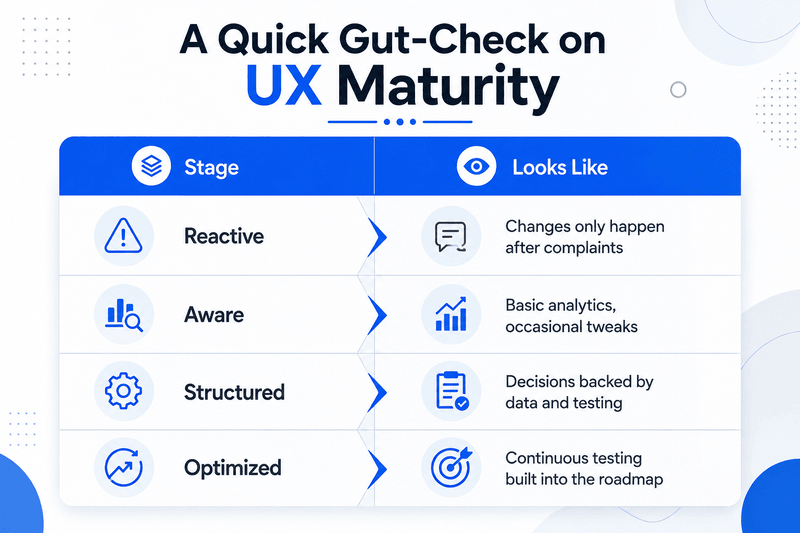
What to Actually Measure
On the business side: conversion rate, session duration, form completions, cart abandonment, repeat visits.
On the technical side: Core Web Vitals, mobile speed, bounce rate by device, WCAG compliance.
Not every trend suits every business. A finance or healthcare site chasing playful animations can end up looking less credible, not more. Pick trends deliberately, not because a competitor did.
What's Coming Next
AI-assisted personalization that adjusts layout based on behavior, voice-search-friendly content structure, Core Web Vitals mattering more directly for rankings, dark mode as a standard toggle rather than a novelty, and accessibility audits becoming routine maintenance rather than a one-time fix.
Wrapping Up
A website's design isn't decoration sitting on top of the business, it's often the first real conversation a customer has with you, and it's over before they've read a word. Getting UX right isn't about chasing every trend, it's about asking, on every page, whether it actually helps someone do what they came to do.
If you want an honest read on where your current site stands, get in touch with our team.
FAQs
1. How long does a UX-focused redesign take?
For a mid-sized business site, roughly 6-10 weeks from audit to launch, depending on how ready your content is.
2. Does better UX affect SEO rankings?
Yes, directly and indirectly. Core Web Vitals are a ranking factor, and lower bounce rates signal relevance to search engines.
3. What's a realistic budget for professional UX design?
It varies widely by scope, so it's worth talking to a UI UX design company in Ludhiana for an actual quote rather than relying on generic pricing tables.
4. Can an existing site be improved without a full rebuild?
Often, yes. Fixing navigation, speed, and mobile layout can improve UX a lot without touching the whole architecture.
5. How do I know if my site has a UX problem?
High bounce rates and low form conversions relative to traffic are usually the first signals worth digging into.