


Why Cheap Websites Cost More in the Long Run
I've lost count of how many business owners have come to us saying some version of "my nephew built our site for free, but now nothing works." It's rarely the nephew's fault. It's what happens when a website gets treated as a one-time expense instead of a business asset. Google research found that 53% of mobile website visitors will leave a page if it takes more than three seconds to load — and a site that was cheap to build but slow to load is quietly bleeding customers you never even knew visited. That's the real cost of "affordable," and it usually doesn't show up on the invoice.
This is the trap a lot of small and mid-sized businesses fall into when they're comparing website design and development cost in Ludhiana. The lowest quote looks like the smart choice on day one. Eighteen months later, it's the reason you're rebuilding from scratch, paying twice for something you should have gotten right the first time.
What Does "Cheap" Actually Mean in Web Development?
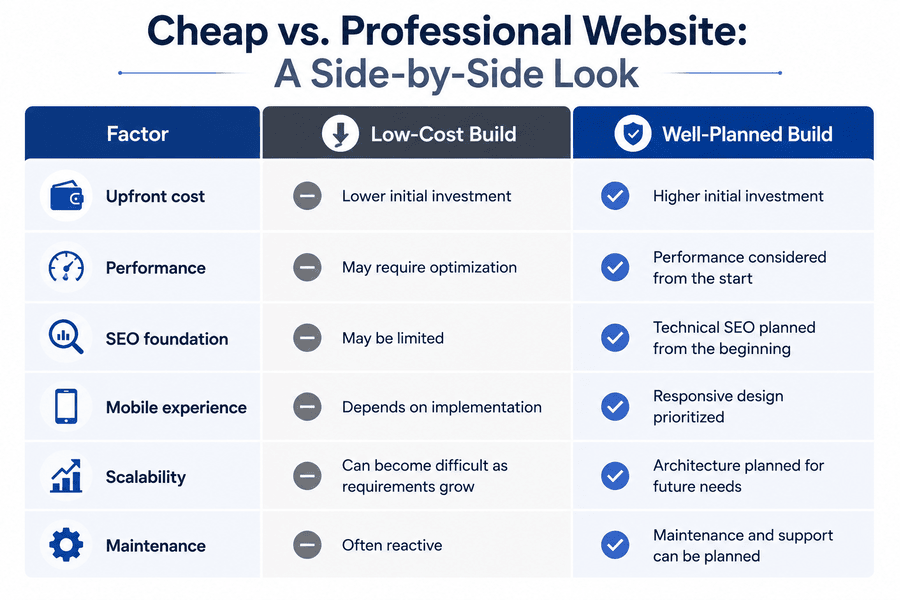
A cheap website isn't necessarily a low-priced one. Plenty of well-built sites are reasonably priced. Cheap refers to shortcuts taken to hit a number, usually at the expense of things a business owner won't notice until later. It typically includes:
- Template-based design with no real customization for your brand or industry
- Bloated, unoptimized code that slows down load times
- No SEO foundation — meta tags, schema, sitemap structure all skipped
- Weak or non-existent security (outdated plugins, no SSL hygiene, no backups)
- Little to no post-launch support once the invoice is paid
The real difference isn't whether choosing a freelancer or an agency. It's whether the project has a clear process for design, development, SEO, security, testing, and ongoing support.
Why Businesses Eventually Choose to Invest Properly
Most of our clients who come from a bad cheap-website experience end up choosing a proper rebuild because it:
- Loads fast enough to keep visitors from bouncing before the page even renders
- Ranks in Google instead of sitting invisible on page 7
- Scales as the business adds products, locations, or services
- Survives a security audit instead of failing one
- Actually converts visitors into leads, not just traffic
The Hidden Costs Nobody Warns You About
A lot of the real damage from a cheap website doesn't show up in the first few months, it shows up slowly, in ways that are hard to trace back to the website itself.
- Lost search visibility because there was never any technical SEO to begin with
- Higher ad spend to compensate for a site that doesn't convert organically
- Emergency fixes when the "developer" stops responding to calls
- Security incidents that cost far more than the original build did
- Rebuilding the entire site within 18 months instead of 3-5 years
Mittal Technologies Insight: We've seen businesses come to us with websites that were initially built on a very limited budget but later required repeated fixes, plugin updates, performance improvements, and SEO work. By the time those issues are addressed, the total cost can be far higher than investing in a properly planned website from the beginning. That's why it's worth evaluating a website development team based on its process, technical expertise, and post-launch support, not simply the lowest quote.
Where the Real Value Shows Up
A properly built website earns its cost back in a few specific places:
- Search rankings that compound over time instead of resetting with every rebuild
- Faster page speed, which directly affects both rankings and conversions
- A design system that can grow with new pages, services, or locations
- Fewer support fires, because the foundation was done right the first time
- A brand impression that matches the quality of the business behind it
If you want to see what that actually looks like in practice, our team's approach to custom website development is built specifically around this long-term thinking rather than a quick, cheap turnaround.
How a Proper Website Build Actually Works
- Discovery call — understanding your business, competitors, and goals before touching a single design file
- Sitemap and UX planning — mapping out pages and user flow so nothing gets bolted on later
- Design — custom visuals aligned to your brand, not a recycled template
- Development — clean, optimized code built for speed and scalability
- SEO foundation — schema, meta tags, sitemap, and technical setup from day one
- Testing — across devices, browsers, and load conditions before launch
- Launch and support — ongoing maintenance instead of disappearing after payment clears
Common Challenges (and How to Actually Fix Them)
Challenge: Budget pressure pushes you toward the cheapest quote. Best Practice: Compare total cost of ownership over 3 years, not just the upfront number — a ₹30,000 gap upfront often saves ₹1,00,000+ down the line.
Challenge: No clear idea of what "professional" actually includes. Best Practice: Ask for a scope breakdown — SEO setup, security, support terms — before comparing prices at all.
Challenge: Fear of overpaying for something oversized. Best Practice: A good developer scopes to your actual business size, not a one-size-fits-all package. Genuinely affordable website development services in Ludhiana exist, they just aren't the ones skipping SEO and security to hit a low number.
Challenge: Not knowing who to trust. Best Practice: Ask for real client examples. Our case study on personal branding for Zaffar Khan is one example of what a properly scoped build actually delivers.
Where This Is Heading
- More businesses are treating websites as ongoing investments, not one-off purchases
- AI-assisted search, including Google's AI Overviews and AI Mode, makes strong technical SEO and helpful, well-structured content increasingly important for search visibility.
- Core Web Vitals remain part of Google's search systems, making website performance an important consideration alongside content relevance and other SEO signals.
- Security expectations are rising as data privacy regulations tighten
- Mobile-first design is no longer optional, it's the baseline
- Businesses are increasingly asking for maintenance and support built into the contract, not as an afterthought
The Bottom Line
A cheap website isn't really cheap, it just delays the real cost and adds interest. If you're evaluating website development costs, it's worth thinking in terms of what the site needs to do for your business over the next few years, not just what it costs to launch next month. Curious what a properly scoped build would actually cost for your business? Get in touch with our developers and we'll walk you through the real numbers, no pressure.
FAQs
1. Is a cheap website ever a good option?
Yes, if you only need a simple temporary site, landing page, or placeholder. But if the website is going to represent your business for years, cutting too many corners can end up costing more in fixes, updates, and lost opportunities.
2. How much does website development cost?
There's no fixed price because it depends on the size and requirements of the project. A small business website may start around ₹50,000, while more complex websites with custom features, integrations, or ecommerce functionality can cost considerably more.
3. How long should a website last before needing a redesign?
There's no set expiration date for a website. A well-built site can stay effective for several years if it's regularly maintained and updated. A redesign may become necessary sooner if the technology, design, performance, or business requirements have changed significantly.
4. What's the biggest hidden cost of a cheap website?
Lost opportunities are often the biggest cost. If a website is slow, difficult to use, poorly optimized for search, or unable to convert visitors into enquiries, the money saved during development can quickly be outweighed by missed leads and sales.
5. How do I know if my current website needs a rebuild?
Start with an audit rather than assuming you need a complete rebuild. If your site is consistently slow, difficult to update, not performing well in search, poorly optimized for mobile, or no longer reflects your business, it may be time for a redesign or rebuild.