


Which Type of Website Is Right for Your Business?
We had a client last year who spent close to two lakhs on a website with parallax scrolling, a video background, and animations on every single section. Gorgeous to look at. Converted almost nobody. It turned out he ran a two-person accounting firm, and what his actual clients wanted was a phone number, a list of services, and proof he wasn't a scam. That's the whole problem in a nutshell — figuring out which type of website is right for your business isn't a design question first, it's a business question, and even the best website development company will tell you that if you ask them honestly.
Most people answer it backwards. Contentsquare's 2026 Digital Experience Benchmark, based on 99 billion sessions across 6,500+ websites, found that conversion rates fell 5.1% year over year. The finding reinforces a point many businesses overlook: getting visitors to your website is only half the job. The experience has to make the next step clear and easy.
Not Every Website Is Solving the Same Problem
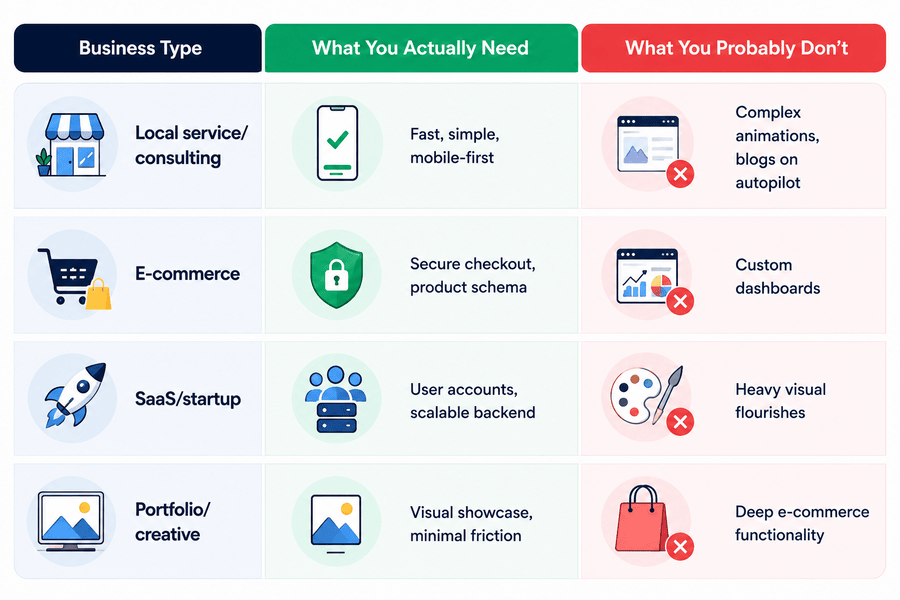
Here's something a lot of business owners don't think about until it's too late: a website isn't one product. A brochure site, an online store, a booking platform, and a SaaS dashboard are built on completely different logic. They don't just look different — the whole thinking behind them is different. A restaurant doesn't need a checkout flow. A custom software development company doesn't need a menu page. Sounds obvious written out like that, but we still see businesses paying for features they'll never use because a template came bundled with them.
If you're a service-based business consultants, clinics, coaching, trades, you genuinely don't need much:
- A homepage that says what you do in one sentence, not five
- Service pages people can actually skim on a phone
- Contact info that's not buried three clicks deep
- Some proof you're legitimate — reviews, credentials, past work
That's it, mostly. We've watched service businesses agonize over color palettes when their real problem was a contact form that took four fields too many.
Selling Products Changes Everything
The moment you're taking payment online, the rules shift completely. Now you need a working cart, a payment gateway that doesn't randomly fail at checkout (this happens more than people admit), inventory that updates in real time, and product pages with enough detail that someone trusts you with their card number without ever meeting you. This is usually where DIY builders start showing their limits — they're fine for five products, rough for five hundred.
I'll be honest, this is the category where hiring a proper web design & development services team actually pays for itself fastest. Cart abandonment, broken payment flows, and slow product pages cost real revenue every single day they go unfixed, and most business owners don't have the bandwidth to debug that themselves while also running the business.
And Then There's Software, Which Is Its Own Beast
If you're building something with user logins, dashboards, or any kind of ongoing functionality, you're not really building a "website" anymore — you're building a product, and the website is just the front door. This needs actual engineering: authentication, database architecture, API integrations, hosting that can scale. We've seen founders try to build this on a page builder because it worked fine for their last brochure site. It doesn't hold up. Not even close.
A Quick Way to Sort This Out
Honestly, before spending a single rupee on design, sit down and answer this: what does someone do on your site once they arrive? Read and call you? Buy something directly? Log in and use a tool? That one answer tells you 80% of what your website structure needs to look like.
Where People Get This Wrong (and It's Expensive)
A few patterns I keep seeing, over and over:
- Choosing a platform because a competitor uses it, not because it fits
- Adding e-commerce "just in case" they sell online someday — bloats the build for nothing
- Skipping mobile-first design because the demo looked good on a desktop monitor
- Not planning for growth, then paying twice to rebuild eighteen months later
That last one stings the most. We've had founders come back a year later needing a full rebuild because the original site was never built to handle what the business became. Cheaper upfront, more expensive over time. Classic trade-off nobody warns you about.
So, Which One Fits You?
There isn't a universal answer, and honestly I'd be suspicious of anyone who gives you one without asking questions first. What matters is matching the website type to how customers actually behave with your business — not to what looks impressive in a portfolio. A website designing agency worth its fee will ask about your customer journey before they ever open Figma. If they skip straight to visuals, that's usually a sign they're building for themselves, not for you.
Get this decision right early, and everything downstream SEO, conversions, maintenance costs, gets noticeably easier. Get it wrong, and you're stuck paying to unwind decisions made in week one.
FAQs
1. How do I know if I need e-commerce functionality or just a service page?
If customers pay you directly through the site for physical or digital goods, you need e-commerce. If they're booking a service delivered offline, a simpler service-based site usually converts better and costs less to maintain.
2. Is it worth starting simple and upgrading later?
Yes, as long as the initial build is on a structure that can actually scale. Cheap platforms that can't be extended tend to force a full rebuild rather than an upgrade.
3. Does website type really affect SEO?
Quite a bit, actually. E-commerce SEO, local SEO, and content SEO all need different structures, so your website type shapes your whole search strategy from the start.
4. How do I choose between multiple web design options?
Ask each one how they'd structure your site around your specific customer journey. If the answer is generic, that's a red flag regardless of how nice their portfolio looks.
5. What's the biggest mistake businesses make when picking a website type?
Choosing based on what looks impressive rather than what the business actually needs — this is how budgets get wasted on features nobody ever uses.