


What Is Entity-Based SEO? Why Does Google Care More About “Things” Than Keywords?
The Knowledge Graph presently contains more than 500 billion facts about nearly 5 billion entities and is growing every quarter (Google). If you run a business in Punjab and still measure SEO success by how many times "digital marketing" appears on a page, this statistic should make you think twice. Google stopped scanning pages like a checklist a while ago. He reads them like a private eye attempting to figure out who you are, what you really do, and whether it can trust you enough to suggest you. This is exactly why so many owners looking for the top SEO firm in Ludhiana or a good digital marketing agency Ludhiana wind themselves bewildered when their keyword-stuffed pages still don’t rank. Often the problem is not effort. It's that the content was developed for an algorithm that no longer exists.
What is SEO Based on Entities?
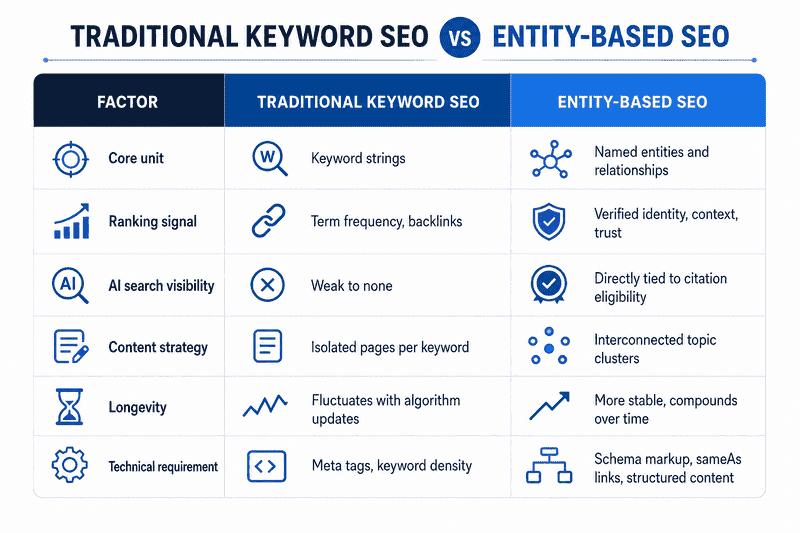
In plain language, entity-based SEO is about helping search engines recognize your business as a specific, real “thing” – a unique entity, with a name, a location, services, and connections to other known entities – instead of just a collection of matching words. Google’s own expression for this, dating back over a decade now, is “things, not strings.” A string is just text. A thing is an idea of identity.
This usually consists of:
- Structured data (schema markup) that directly tells Google, "this is an Organization", "this is a Service", "this is a Person"
- Consistent NAP (name, address, phone) and brand mentions across the web
- internal linking that connects related concepts instead of standalone pages
- Third-party validation – directories, citations, press mentions, Wikidata were relevant
- Content that shows true depth on a topic instead of random keyword variants
Why Companies Are Transitioning to Entity-Based SEO
More and more owners looking for SEO services in Ludhiana are specifically asking for this strategy and it’s not just a case of chasing a trend. The outcome is usually:
- Better visibility in AI Overviews and answer boxes based on confirmed entities rather than crawling complete articles
- Stronger topical authority, so one good page elevates the whole cluster instead than competing with itself
- More resilience to algorithm modifications, as entity signals are tougher to game and take longer to be eroded
- Differentiate better from competition with similar names or overlapping services
- Long-term brand reputation that builds on itself, not rankings that reset every time Google alters its formula
Building Your Business as an Entity Recognized
Before content or links matter much, Google has to recognize that you are there as a consistent entity in the first place. This is a basic section, and missing it undermines everything that follows.
- Sign up and thoroughly complete your Google Business Profile with consistent information.
- Add Organization and LocalBusiness schema markup to your homepage and important service pages
- Add or claim pertinent directory listings that have the correct NAP information
- Link your official social profiles sameSchema so Google can make the connections
- Actually tell me who you are, not simply what you sell on your About page.
Mittal Technologies Insight: " I’ve seen companies spend a lot of money on content before they’ve even laid the basis for their entity. It’s like putting the decorations in a house before they’ve poured the concrete. First get schema and profile consistency right, then all your efforts afterwards tend to go further.
Entity Recognition Content Strategy
Once in place, content ought to enhance your entity base, not dilute it. This is where depth of topic starts to matter over volume.
- Develop pillar pages for essential service entities, with supplementary material branching off in a natural way
- Include all the main entities in your content; don’t expect Google to understand them by itself.
- Internal links should link similar themes and not just random cross-promotion.
- Refer to external authoritative sources (industry bodies, recognized tools, acknowledged publications) if appropriate
- Don’t create shallow, individual blog posts that don’t tie back to a bigger topical structure.
Now, compare this with the work of a standard digital marketing business in Ludhiana, and the difference is usually in whether the material is designed as an ecosystem or created page by page with no actual map behind it. Our digital marketing services are developed around this cluster first approach, rather than a one-off keyword focus.
Technical implementation that works in practice
Technical SEO is the make or break of Entity SEO success. Good intentions alone, without the right markup, won’t shift the needle.
- Use JSON-LD schema instead of microdata, it’s cleaner and it’s Google’s preferred format.
- Before you publish, validate each schema type with Google’s Rich Results Test
- Make sure canonical tags lead to the correct, unique version of each page
- Keep your sitemap up to date and published to Search Console
- Audit for duplicate or contradictory entity signals on sites that confuse more than help
In fact, we had this kind of technical issue while working on the RPM Garage automotive platform. Inconsistent structured data was silently working against the visibility of the client before we cleaned it up.
7-Step Process to Roll Out Entity Based SEO
- Audit your current entity presence - Check Knowledge Panel status, existing schema and directory consistency.
- Identify your main entities - lay out your brand, services, people and locations as separate, identifiable things.
- Build the technical foundation - Implement schema markup and resolve NAP inconsistencies throughout the web.
- Construct topic clusters - construct pillar and supporting information that explicitly defines and connects items.
- Look for third party validation - Citations, mentions and related directory or wikidata entries.
- Entity recognition monitoring - Monitor Knowledge Panel appearance, Mentions of AI Overview and Branded Search Volume.
- Iterate quarterly - Review and change every several months, not daily. Entity signals are slow-moving, iterated quarterly.
Common Challenges (And How to Actually Fix Them)
- Inconsistent NAP data across the web - Best Practice: Conduct a comprehensive citation audit and rectify every inconsistency, even little ones like a missing suite number.
- Schema issues going unreported for months - Best Practice: check schema after every update to the site, not just at launch.
- Confusing your entity with a similarly named competitor - Best Practice: Strengthen disambiguating signals such as distinct descriptions, sameAs links, and geographical specificity.
- Treating material as discrete blog entries instead of a cluster - Best Practice: plan out subjects before you write a single word, and consciously link.
- Fast results are expected - Best Practice: be honest about expectations. Entity recognition usually takes months, not weeks, and trying to speed it up using manipulative approaches can backfire.
Success Metrics That Count
Business KPIs:
- Brand search volume growth
- Knowledge Panel Display
- Volume of organic search qualified leads
- Named competitors vs. share of voice
Technical KPIs:
- Schema validation success rate
- AI Overview Frequency of Citation
- Crawl and index status
- Internal connection depth around topic clusters
Where This is Going
- AI Overviews and AI Mode will continue to lean more into entity data vs page level keyword matching
- Wikidata items are more accessible, and increasingly relevant for smaller, regional enterprises, not simply worldwide names.
- Clear disambiguation of entities will be almost entirely the foundation of voice and conversational search
- As AI parsing improves, schema markup requirements will likely expand beyond the standard types currently in use.
- Businesses who get entity clarity early will have a real head start against slower competitors
Conclusions
Entity-based SEO isn’t a passing framework. It’s more like how search itself fundamentally works now. Ignoring it means you are progressively losing ground you didn’t realise you were losing. If you’re searching for SEO companies in Ludhiana and want an approach built around this reality rather than obsolete keyword techniques, our team would be happy to walk through where your present entity's presence stands. Feel free to contact us at any time that suits you.
FAQs
Q. Is entity SEO the same as schema markup?
No. Schema is one of the tools to indicate entities however entity SEO also includes NAP consistency, 3rd party validation and topical content structure.
Q. How long does it take to complete entity recognition?
3-9 months typically once reliable signals are in place. For specialist topics with little competition can happen quicker.
Q. Is this for major companies, or do small local businesses require this?
Local businesses could be better off now with AI Overviews surfacing more locally-verified entities for "near me" and city-specific searches.
Q. Is entity SEO a replacement for traditional keyword research?
Keywords still matter to interpret search intent nonetheless. Entity SEO is built on top of it, not because of it.
Q. What is the biggest error that firms make with entity SEO?
Jumping into the content and skipping the foundational entity setup (schema, NAP consistency) and leaving content without a solid connection to it.