


Website Development Timeline: From Planning to Launch
A client once asked me for a "quick two-week website" and got visibly annoyed when I said it would realistically take six. He'd been quoted two weeks by someone else, signed on, and three months later called me anyway because the site still wasn't live. That's not a rare story. WebFX reports that 63% of website traffic came from mobile devices in 2024, which is one reason mobile-first development has become an important part of modern website planning. So, when a website development company hands you a fixed, suspiciously fast timeline before they've even seen your content, treat that as a sales pitch, not a plan. A realistic website development timeline isn't about picking the smallest number that sounds impressive. It's about knowing which phases genuinely control the pace, because that's where projects stay on track or quietly fall apart.
What's Actually Inside a Development Timeline
People hear "building a website" and picture someone typing code for a few weeks. In reality, a proper build moves through several distinct phases, and skipping any one of them tends to show up as a delay two stages later:
- Discovery and requirement gathering
- Sitemap and content structure planning
- UI/UX design and wireframes
- Front-end and back-end development
- Content and copy integration
- QA testing across devices and browsers
- Launch, followed by post-launch monitoring
Each phase leans on the one before it. Rush discovery, and you'll feel it in development. Rush testing, and you'll feel it after launch, usually at the worst possible moment.
Why the Timeline Actually Matters
- It keeps budgets from quietly ballooning once "small changes" start piling up
- It lets you plan a marketing launch around a date you can actually trust
- Quality holds up better when phases aren't compressed under deadline pressure
- Everyone involved stays aligned instead of guessing what's happening
- Post-launch bugs drop noticeably when testing isn't rushed at the end
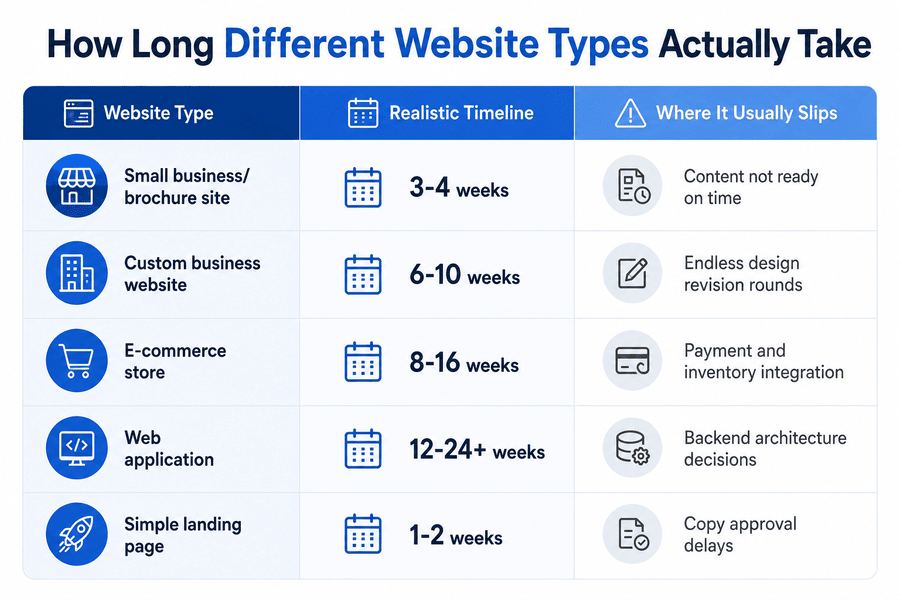
Phase One Is Where Most Delays Actually Start
Everyone wants to rush past discovery and get to the "fun part." That's usually the most expensive shortcut a business takes.
- Defining what the website genuinely needs to achieve, not just look like
- Understanding how the target audience actually moves through a decision
- A quick competitor scan to spot gaps worth addressing
- Locking tech stack and integrations before design work even begins
- Setting a real budget range instead of an aspirational one
I've seen this play out more times than I can count: a client thinks a day spent clarifying scope is wasted time, when it's usually the cheapest insurance in the entire project.
Design Decides How People Actually Move Through the Site
Design isn't decoration. It's the difference between someone finding what they need and someone bouncing after eight seconds.
- Wireframes mapping content hierarchy before anyone touches color or fonts
- Visual design reflecting the brand without sacrificing basic usability
- Mobile-first thinking, since most traffic isn't landing on a desktop anymore
- Interactive prototypes so feedback happens before code gets written
- Accessibility built in early rather than patched on at the very end
Development Is Where Earlier Decisions Either Pay Off or Bite Back
This is the stage most people picture when they think "building a website," and it's genuinely where the earlier planning either saves you time or costs you extra rounds of fixes.
- Front-end coding matching the approved design, not a rough approximation of it
- Back-end work handling databases, logins, and dynamic functionality
- Third-party integrations like payment gateways, CRMs, and analytics
- CMS setup so future content updates don't need a developer every time
- Performance work built in throughout, not bolted on the week before launch
I'll be blunt about this one — clients often assume speed optimization is a last-minute task. It's not, and treating it that way is exactly why some sites launch fast and then need three rounds of "why is this slow" fixes afterward. Custom web development services that take performance seriously from day one avoid that entirely.
Testing and Post-Launch Monitoring
And it's usually the phase that punishes you hardest for shrinking it.
- Cross-browser and cross-device checks before anything goes public
- Load testing so the site doesn't buckle under real traffic
- Security scans, SSL checks, basic data protection review
- A staging environment review before the public launch
- Thirty to sixty days of post-launch monitoring to catch what testing missed
A Realistic Process, Start to Finish
- Discovery call to pin down goals, scope, and a believable budget range
- Sitemap and content planning built around actual target keywords
- Wireframes and design mockups, reviewed properly with stakeholders
- Development done in stages, with regular check-ins, not one big reveal
- Content and copy prepared in parallel with development, not after it
- QA testing across real devices and real user scenarios
- Launch, then active monitoring for the following month or two
Where Projects Actually Go Wrong
- Content isn't ready when development needs it, so everything stalls
- Scope quietly expands mid-project without anyone formally agreeing to it
- Design approval drags on for weeks with no clear limit on revision rounds
- Testing gets compressed to hit a launch date that was never realistic
The content delay is the one I'd flag hardest, because it's almost always avoidable. Starting copywriting in parallel with design instead of after development begins can prevent a surprising number of timeline problems.
What the Numbers Actually Tell You
Business KPIs worth tracking
- Launch date accuracy
- Budget variance from the original quote
- Number of stakeholder revision cycles
- Time to first lead after launch
Technical KPIs worth tracking
- Page-load performance at launch
- Cross-device bug count
- Uptime in the first month
- Core Web Vitals scores
Choosing Who Builds It
Picking a web design agency based purely on who quotes the fastest turnaround is how a lot of these delays happen in the first place. Speed without proper discovery and testing tends to show up later as expensive fixes, not savings. A team that pushes back on an unrealistic timeline is usually more trustworthy than one that agrees to anything you ask for.
Final Thought
A realistic timeline isn't about promising the smallest number — it's about knowing which phases genuinely need time and which ones move fast once the groundwork is solid. Both Website development cost and timeline both stretch the moment planning gets skipped, and no amount of good design fixes that afterward. Worth remembering before you sign off on a launch date that sounds too good to be true.
FAQs
1. How long does a typical business website actually take to build?
Most custom business websites take around 6-10 weeks from discovery to launch, depending on design complexity, functionality, and how quickly content gets delivered.
2. What drives up the final cost the most?
Custom functionality, third-party integrations, and the number of design revision rounds usually matter more than the platform itself.
3. Can a bigger budget make a website launch faster?
To a point. More resources can run phases in parallel, but design approval and content readiness still put a natural floor on how fast things move.
4. Is a faster quote always a red flag?
Not always, but a suspiciously fast timeline with no discovery phase can mean something important is being skipped, and that often shows up later.
5. What's the single most common reason projects miss their launch date?
Late content delivery, followed closely by mid-project scope changes — both ahead of purely technical delays.