


How Much Does Social Media Marketing Actually Cost for Small Businesses?
I get asked this question at least once a week, usually by a shop owner or a startup founder who's just been quoted three wildly different numbers by three different agencies. And honestly, the confusion is fair. There's no single "correct" price for social media marketing, and anyone who gives you a flat number without asking about your goals first is guessing.
Here's a stat worth sitting with before we get into pricing. HubSpot's 2026 Social Media Marketing Report, which surveyed over 1,100 global marketers, found that brand awareness has pulled ahead of every other goal this year - cited by nearly 59% of social teams as their top priority, more than double its share from the year before. That shift matters for budgeting, because awareness-driven work looks different from a lead-gen sprint, and it costs differently too. If you're running a local business searching for a social media marketing agency in Ludhiana, or just trying to understand what you're paying for before you sign anything, this piece walks through the actual cost drivers, not just a price list.
What Does "Social Media Marketing Cost" Actually Include?
Social media marketing cost is the total monthly or project-based spend a business puts toward planning, creating, publishing, and promoting content across platforms like Instagram, Facebook, and LinkedIn. Businesses exploring social media marketing in Ludhiana usually find this out the hard way, it's rarely just one line item. A realistic budget usually covers:
- Content creation (graphics, video, copywriting)
- Platform management and scheduling
- Paid advertising and boosted posts
- Analytics, reporting, and strategy adjustments
- Tools and software subscriptions
- Community management (replying to comments, DMs, reviews)
Most quotes you get will bundle some of these and exclude others, which is exactly why two agency proposals for "the same service" can differ by a factor of three. It's worth asking, line by line, what's actually included before you compare prices side by side.
Why Small Businesses Choose a Social Media Marketing Agency in Ludhiana
Businesses don't budget for social media because it's trendy, they do it because the returns, when done with any discipline, are measurable. Small businesses see an average return of $5 for every $1 spent on social advertising, and 58% of consumers say they've discovered a new business through social media. That's not a marginal channel anymore, and it lines up with why brand awareness has become such a dominant priority industry-wide this year.
Business owners we've worked with tend to invest for a handful of reasons:
- Local visibility that Google search alone doesn't capture
- Direct customer conversations, which build trust faster than ads
- A content library that can be repurposed across email and the website
- Competitive parity, if your competitor posts consistently and you don't, customers notice
- Lead generation that doesn't depend entirely on paid search
Content Creation and Its Real Cost Drivers
This is usually where budgets swing the hardest, because "content" means very different things depending on the business.
- Static graphic posts cost the least but perform weakest on reach
- Short-form video now drives most organic reach across platforms
- Photography and on-location shoots add real cost but build authenticity
- Batch content production (a full month shot in one day) lowers per-post cost
- Repurposing one asset across three platforms stretches the budget further
Mittal Technologies Insight: We usually tell clients to resist the urge to be everywhere at once. HubSpot's research backs this up too, Instagram alone leads platform adoption at nearly 80%, not because businesses are spread thin across five networks, but because they've picked their strongest channel and gone deep on it.
Paid Advertising: Where the Budget Actually Moves
Ad spend is the most flexible part of the equation, and also the part most likely to be wasted without a strategy behind it.
- Meta CPMs have climbed to roughly $11.20 in 2026, up from around $9.10 in 2024
- LinkedIn CPCs now regularly exceed $5.60 for B2B campaigns
- Boosted posts without audience targeting rarely outperform organic reach
- Retargeting ads to website visitors typically convert better than cold audience ads
- A/B testing creative before scaling spend prevents burning budget on weak ads
Rising ad costs are one reason more businesses are leaning on their existing web presence and case studies to reduce paid dependency, you can see how that played out for one client in our B2B real estate platform case study, where organic and content-driven growth carried a meaningful share of results.
Tools, Analytics, and the Hidden Line Items
Scheduling software, design tools, and reporting dashboards rarely show up in the headline price, but they add up.
- Scheduling platforms (Buffer, Later, Hootsuite) typically run $15-$100/month
- Design tools like Canva Pro sit around $10-$15/month per seat
- Analytics dashboards for cross-platform reporting can add $50-$300/month
- Stock footage or asset libraries add another recurring cost
- Agencies often absorb tool costs into their retainer, worth asking about upfront
Mittal Technologies Insight: Ask any prospective vendor directly whether tools are included in the quoted price. It's a small question that avoids a surprisingly common billing surprise later.
How a Typical Social Media Marketing Engagement Rolls Out
- Audit — review existing platforms, past performance, and competitor activity
- Goal setting — define whether the priority is awareness, leads, or retention
- Platform selection — choose two to three platforms based on where the audience actually is
- Content calendar build — plan a month of posts around themes and campaigns
- Production and scheduling — create and queue content in batches
- Paid amplification — layer in ad spend once organic baselines are established
- Reporting and iteration — review monthly data and adjust the mix
Challenges (an Honest Look)
Challenge: Inconsistent posting. Businesses start strong and taper off within six weeks.
Best Practice: Batch a month of content in a single sitting rather than creating daily under pressure.
Challenge: No clear ROI tracking. Owners can't say what the spend actually produced. This is a widespread problem, not just a small-business one - HubSpot's 2026 report found only 37% of marketers globally say it's easy to connect social activity to business outcomes.
Best Practice: Tie every platform to one measurable outcome leads, calls, or site visits, before spending a dollar on ads.
Challenge: Chasing every platform at once. Thin presence across five networks beats none of them.
Best Practice: Pick the two platforms where your actual customers spend time and go deeper there.
Challenge: Underpricing the creative work. Cheap content often costs more in wasted ad spend later.
Best Practice: Budget slightly more for creative quality; it directly affects ad performance and CPMs.
Challenge: Vendor mismatch. A freelancer skilled at Instagram may be weak at LinkedIn strategy, and not every business calling itself the best digital marketing company in Ludhiana will actually fit your specific platform mix.
Best Practice: Match the vendor's platform strength to your primary channel, not their overall portfolio.
I'll add one honest limitation here too: social media rarely shows a clean, direct line to revenue, especially for longer sales cycles. Anyone who promises airtight attribution is overselling what the channel can actually do.
Success Metrics Worth Tracking
Business KPIs: lead volume, cost per lead, conversion rate from social traffic, repeat customer rate, revenue attributed to social channels.
Technical KPIs: engagement rate by platform, follower growth rate, click-through rate on ads, video completion rate, post reach versus impressions.
Future Trends Worth Watching
- Short-form video continues to outperform static content across nearly every platform
- AI-assisted content drafting is lowering production time, though quality still varies, HubSpot found 94% of marketers already use AI somewhere in their workflow
- Platforms are pushing paid reach harder as organic distribution keeps shrinking
- Authenticity is beating polish - 77% of marketers in HubSpot's survey now say raw, real content outperforms high-production video
- Search behavior is shifting toward social platforms for discovery, not just Google
- Smaller, niche-focused agencies are gaining ground against generalist firms
Wrapping It Up
There's no universal answer to what social media marketing should cost, it depends on your platform choices, your content ambitions, and how aggressively you want to advertise. What matters more than the number itself is whether the spend is tied to something measurable. Businesses evaluating a digital marketing agency in Ludhiana often pair this decision with a look at their SEO services in Ludhiana too, since organic search and social work best when they're planned together rather than bought separately. If you're weighing your options or want a second opinion on a quote you've received, our team at Mittal Technologies is happy to walk through it, or you can get in touch directly.
FAQs
1. What's a realistic starting budget for a small business new to social media?
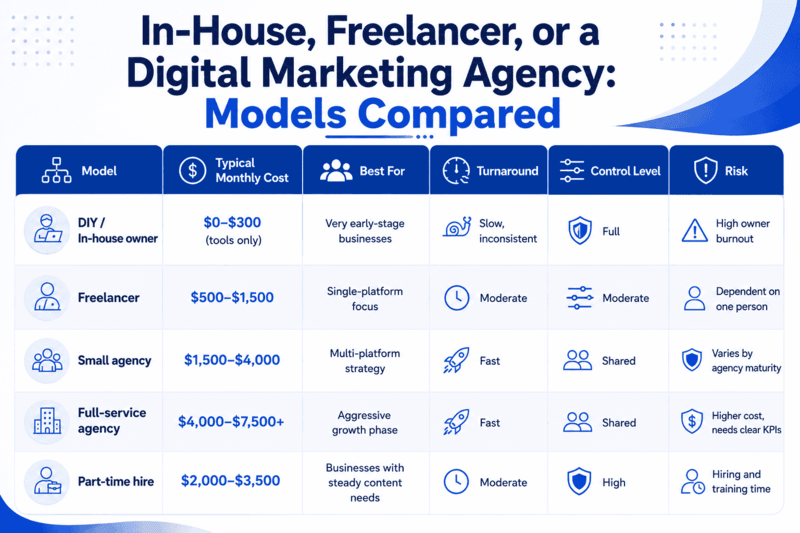
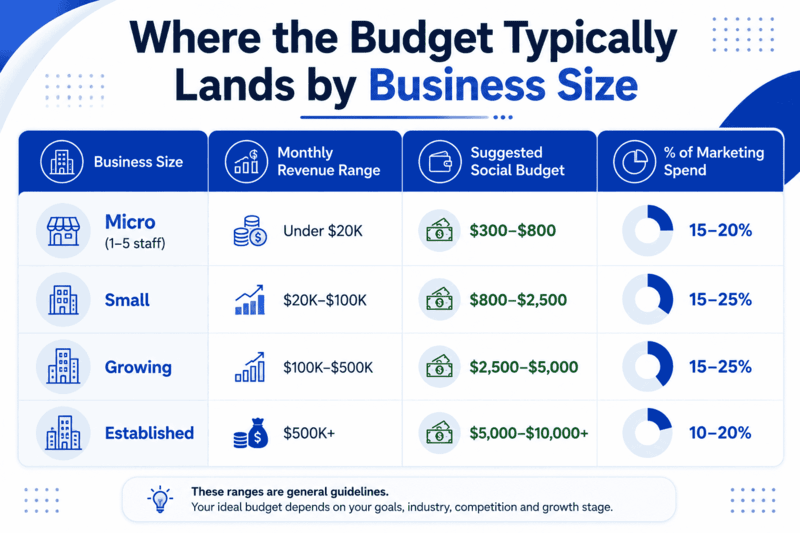
Somewhere between $500 and $1,500 a month is workable for most small businesses starting with one or two platforms.
2. Is it worth paying for ads if I already post organically?
Usually yes, but only once you know which posts perform, boosting weak content just wastes spend faster.
3. Should I hire an agency or a freelancer first?
Freelancers work well for single-platform focus; a best digital marketing agency in Ludhiana makes more sense once you're managing three or more channels with paid ads.
4. How long before social media marketing shows results?
Expect three to six months of consistent activity before you see reliable trends in leads or engagement.
5. Do tools and software really add that much to the cost?
They can add $75-$400 a month depending on how many platforms and reporting layers you use, so it's worth confirming what's included in any quote.