


How AI Is Transforming Small Businesses
I came across a number last week that I had to double-check, because it seemed too high. CPA Australia's Asia-Pacific Small Business Survey for 2025/26 found that AI investment among Indian small businesses climbed from 26% in 2024 to 36% in 2025, overtaking cloud computing as the single biggest tech spend category. Forty-one percent of small business owners are now asking AI tools for actual business advice, not just using them to draft emails. That's not a slow, cautious trend anymore. That's more than a third of small businesses putting real rupees behind AI in a single year.
And yet, most of the small business owners I talk to are still stuck at "should I even bother?" Which is fair, honestly. There's so much noise around AI right now that it's hard to tell what's genuinely useful versus what's just a LinkedIn buzzword dressed up as a product. So, let's skip the hype and talk about what's actually changing on the ground.
What Does AI Transformation Actually Mean Here?
Strip away the jargon and AI transformation just means this: using software that can learn from patterns and make decisions (or suggest them) so your team spends less time on the boring, repetitive stuff. It's not robots taking over your shop. It's more like hiring a very fast, slightly literal assistant who never sleeps and never asks for a raise.
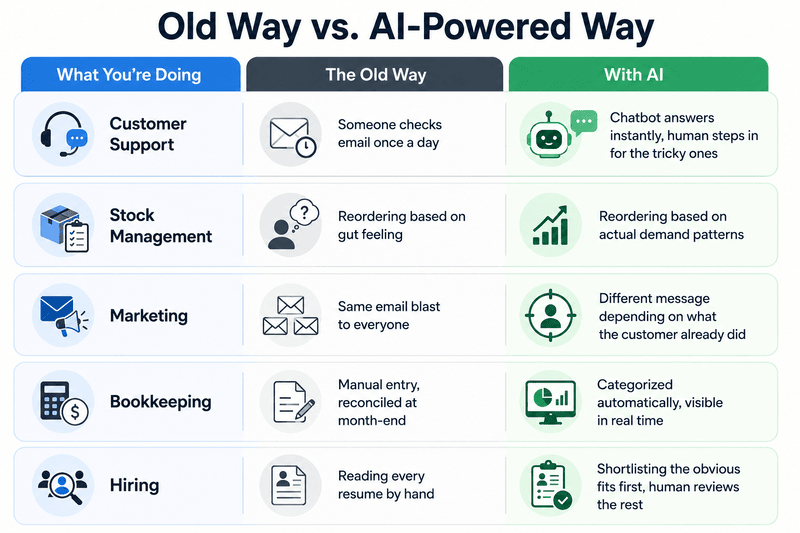
For a typical small business, that usually shows up as:
- Chatbots handling the first round of customer questions
- Automated invoicing and expense sorting
- Inventory forecasting that actually accounts for seasonal spikes
- Marketing emails that adjust based on what a customer actually clicked
- Resume screening for high-volume hiring rounds
None of this is science fiction. Most of it is stuff a decent software development company in Ludhiana can set up for you in a few weeks, not a few months.
Why Owners Are Actually Bothering With This
Nobody adopts AI because a consultant told them it's "the future." They adopt it when it saves money, saves time, or stops a customer from walking away angry. It's the same reason owners go looking for IT companies in Ludhiana in the first place, not for the tech itself, but for what it actually fixes. In practice, that means:
- Cutting down hours spent on admin that nobody enjoys doing anyway
- Catching cash flow problems two or three weeks before they'd normally notice
- Responding to customers in minutes instead of the next business day
- Competing with bigger players who have bigger support teams, without hiring ten more people
Where This Actually Moves the Needle
Customer Support
Small teams can't staff a helpdesk around the clock, and customers don't really care about that. AI chatbots handle the repetitive questions, order status, return policies, opening hours, so your actual team only deals with the messy, human stuff that needs judgment.
- Instant first replies, even at 11pm on a Sunday
- Fewer support tickets piling up over weekends
- Frustrated customers get flagged and routed to a person faster
- Support costs stay flat even when order volume spikes
Marketing That Doesn't Feel Like Guesswork
- Emails that change based on what someone actually browsed
- Ad copy tested automatically instead of one person's best guess
- Early warning when a regular customer starts going quiet
- Clearer picture of which channel is actually working, not just which one feels busy
Mittal Technologies Insight: Most businesses already sit on more customer data than they realize. The problem isn't collecting it, it's that nobody's connected it to anything that actually acts on it. That's usually a bigger fix than buying another tool.
A lot of this traces back to the website itself, honestly. If your site can't track what a visitor actually does, no amount of AI on top of it is going to personalize anything. That's usually the first thing a best website designing company in Ludhiana checks before recommending any automation at all.
Operations Nobody Enjoys Doing Manually
- Invoices that generate and chase themselves
- Expenses sorted without someone squinting at receipts
- Cash flow forecasts based on actual patterns, not last year's spreadsheet
- Unusual transactions flagged before they become a real problem
Hiring Without Losing a Week to Resumes
- Faster first-pass shortlisting for roles with 200+ applicants
- Scheduling that doesn't involve six back-and-forth emails
- New hires getting answers from a bot instead of pinging HR twenty times
Mittal Technologies Insight: AI hiring tools are good at narrowing a huge pile down to a manageable one. They're not great at judging whether someone's actually a fit for your team. We've seen decent candidates get filtered out purely because their resume didn't use the "right" keywords. Keep a human in the loop at the final stage, always.
That last point matters more than people give it credit for. Every recommendation in this piece has come out of actual projects our team has shipped, not from reading someone else's blog post and rewording it.
Actually Getting This Done
Most of this isn't complicated in theory, it just needs someone to actually sit down and do it instead of talking about it in a meeting for three months. This is roughly the order we'd walk a client through if they came to us as the best IT company in Ludhiana for their first AI project:
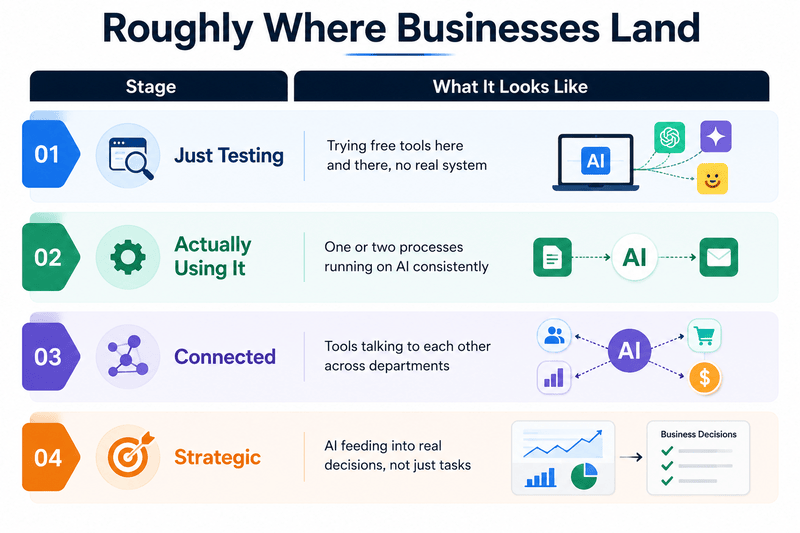
- Write down where your team's time actually goes. Not where you think it goes, track it for a week.
- Pick one thing. Support or invoicing, not everything at once.
- Make sure it plugs into what you already use. A brilliant tool that doesn't talk to your existing systems just creates a second job.
- Fix your data before you automate anything. Garbage in, garbage forecasts out.
- Pilot it for a month or two. Don't roll it out company-wide on day one.
- Train people properly, including when to ignore what the AI suggests.
- Check back monthly. These tools drift and need tuning, they're not "set and forget."
Where People Actually Get Stuck
- Messy data. Half-filled customer records make every prediction worse than a guess. Fix it: Clean your data before you plug in anything predictive.
- Too much automation, not enough humans. Customers can tell when they're talking to a wall. Fix it: Build in clear rules for when a real person takes over.
- Five tools that don't talk to each other. Everyone's guilty of this eventually. Fix it: Consolidate before adding another subscription.
- Underestimating how long training takes. Staff quietly stop using tools they don't trust. Fix it: Budget real time for this, not a fifteen-minute demo.
- Security getting an afterthought. The same CPA Australia survey found nearly half of small businesses already lost time to a cybersecurity incident, and half expect another attack this year. Fix it: Any AI system touching customer or financial data needs proper access controls from day one, not after something goes wrong.
How You'd Know It's Working
Business side: revenue growth, how many customers stick around, cost per support ticket, hours the team actually gets back each week.
Technical side: how often the chatbot resolves things without escalation, how accurate the forecasts turn out to be, uptime, how fast data actually moves between systems.
What's Coming Next
- Industry-specific AI tools replacing the generic ones
- Voice assistants showing up more in customer service, not just chat
- Predictive analytics getting cheap enough for genuinely small budgets
- Cybersecurity built into AI tools by default, not bolted on later
- More scrutiny from regulators around how customer data gets used
- Businesses that blend human judgment with automation outperforming the ones that go fully hands-off
Wrapping This Up
AI isn't going to run your business for you, and anyone telling you it will is selling something. What it can genuinely do, if you set it up properly, is take the repetitive weight off your team so people spend time on the parts of the job that actually need a brain. That's the approach we take at Mittal Technologies, whether that's AI workflows or the systems underneath them.
If you're comparing us against other top software companies in Ludhiana, skip the sales call for now. Send us the one process eating up the most time on your team, and we'll tell you straight whether AI is actually the right fix for it or not. Get in touch and we'll give you a real answer, not a pitch.
FAQs
1. Is this expensive for a small business to start?
Not really, most tools start cheap or usage-based. Start with one process instead of a big upfront spend and you'll know within a month or two if it's worth expanding.
2. Is AI going to take jobs at my company?
It shifts what people spend their time on more than it replaces them outright. The repetitive stuff goes to the tool, the judgment calls stay with people.
3. How fast do you actually see results?
Most businesses notice something within 60 to 90 days on a focused pilot. Full integration across the whole business takes longer, and that's normal.
4. Do I need a technical person on staff for this?
Not necessarily. A lot of tools are built for non-technical owners now, though working with someone experienced cuts down the trial and error a lot.
5. What's the mistake you see most often?
Trying to automate five things at once instead of proving one thing works first. That's usually where the budget quietly disappears.