


10 Questions to Ask Before Hiring a Website Development Company
I've sat through a lot of sales calls with website agencies over the years, and most of them sound the same after the first five minutes. Everyone promises a "stunning, modern, mobile-friendly" site. Nobody tells you what happens when the invoice for revision number four shows up. If you're trying to figure out which website development company in Ludhiana is right for your business, the pitch isn't where you'll find the answer — the questions you ask before signing are.
Forbes Advisor's 2025 website statistics report found that 57% of users won’t recommend a business with a poorly designed website. That number stuck with me because it's not about design taste. It's about trust breaking down somewhere between a slow homepage and a confusing checkout button. I've watched small business owners lose customers this way without ever knowing why, because nobody connects a dip in inquiries to a website that quietly stopped working for people.
So, before you sign with anyone, here are ten questions worth asking. Some of them will feel a little uncomfortable to ask out loud. Ask them anyway.
1. Who's actually building my site?
Not "the team" in some vague collective sense — the actual people. Agencies often show you their most experienced person on the sales call, then hand your project to whoever's free that week. That's not always a bad thing, junior developers can be sharp, but you deserve to know.
2. Can you show me a live site, not a portfolio screenshot?
Screenshots hide slow load times, broken mobile menus, and dead links. Pull it up on your own phone. If they're proud of the work, they won't mind.
3. What exactly is included in the website design & development cost?
This is where most disputes start, and I say that from watching it happen more than once. A quote for website design and development cost can look identical on paper between two agencies and mean completely different things — one includes hosting setup, revisions, and a month of support, the other charges extra for all three.
4. What technology or CMS will you use, and why?
Ask why they recommend WordPress, Shopify, a custom solution, or another platform. The right choice should fit your needs, budget, performance, and future growth. Also ask whether the technology can handle future integrations, traffic growth, and new features without requiring a complete rebuild.
5. Is the site being built mobile-first, or just mobile-friendly?
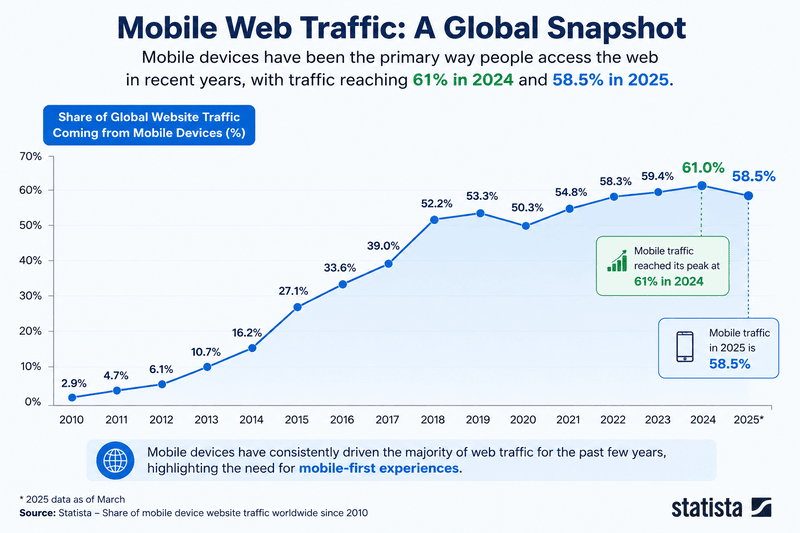
There's a real difference. Mobile-friendly means it doesn't break on a phone. Mobile-first means it was designed for a phone screen first, then scaled up. With mobile devices accounting for more than 60% of global web traffic in recent years, a mobile-first website isn't a nice-to-have anymore.
6. Who owns the code and the domain once it's finished?
I've seen this bite people. A business wants to switch developers two years later and discovers the old agency still controls the website, domain, or CMS access. Get ownership and access terms in writing before you pay a rupee.
7. Is SEO built in from the start, or sold as an add-on later?
Clean URLs, proper headings, image optimization, and crawlability should be considered during development, not treated as an afterthought once the site is live.
8. What does support look like after launch?
Bugs happen. Plugins need updates. Ask what's free and what triggers a new bill, and get a real timeframe, not "we'll be around." Also ask whether support includes security updates, backups, and fixing issues caused by future software or plugin updates.
9. Can you show a real project similar to my industry or business size?
Anyone claiming to have "done everything" for "everyone" is being vague on purpose. A team that can walk you through a real project, like this B2B real estate platform build, is giving you evidence instead of promises. You can see what problem it solved, how it was approached, and what the project involved.
10. What is the realistic timeline for the project?
Ask for a clear timeline covering design, development, revisions, testing, and launch. Also clarify what could cause delays and what they need from you to stay on schedule.
Mittal Technologies Insight: We've seen businesses switch developers before finding one who simply answers these questions straight. It's rarely about talent; it's about whether the agency treats communication as part of the deliverable, not an afterthought.
Common Mistakes Businesses Make
- Choosing on price alone. Best Practice: compare scope, not just the number at the bottom of the quote.
- Skipping the contract details. Best Practice: insist on ownership, timeline, and revision terms in writing before any advance payment.
- Ignoring post-launch plans. Best Practice: ask what a typical month of support looks like once the site is live.
- Not checking mobile experience. Best Practice: test their sample sites on your own phone before deciding.
How to Choose the Right Website Development Company
There's no single "best" website development company for every business — it depends on your budget, industry, and how hands-on you want to be. A small local shop needs something different from a growing B2B service provider. What matters is matching the agency's experience, technology and support model to your actual goals.
That said, budget-conscious doesn't have to mean corner-cutting. There are genuinely affordable website development services in Ludhiana that do solid, honest work — you just have to ask the same ten questions of them that you'd ask a premium agency. The businesses that get burned usually skip the questions, not the research.
If you want to see the kind of people who'd actually be answering these questions for your project, it's worth a quick look at our expert development team before you decide anything.
Wrapping Up
A website is one of the few things in your business that works at 2 a.m. while you're asleep, quietly bringing people in or quietly pushing them away. It deserves more scrutiny than a five-minute call and a nice-looking mockup. Ask the ten questions. Compare the answers honestly. And if you'd rather talk it through with someone who's seen both the good and bad versions of this process, get in touch with our team — no sales script attached, just an honest conversation.